

Read The
Current Issue
By Molly Absolon // Photography by Paul Lavold
—
Midway up the stairs in architect Sarah Post-Holmberg’s home along Fox Creek in Teton Valley, Idaho, there’s a perch. From the cushioned bench, you can look out over the expanse of the living area to a wall of windows that frames the distant Big Hole Mountains. It’s a cozy spot for reading, listening to music, or watching the activity below.
Such a space is important to biophilic design, according to Post-Holmberg, who tries to incorporate its principles into her work. She says humans need a place of refuge, where they can restore themselves and feel safe. At the same time, we also crave prospect, which can be defined as a sense of space or an expansive outward view. The nest partway up Post-Holmberg’s staircase has elements of both refuge and prospect.
“There’s tension between the idea of refuge and prospect,” Post-Holmberg says. “Humans want both. Sitting on that perch during a snowstorm feels like you are in a snow globe — it’s wild and stormy — and yet at the same time you are warm, cozy, and safe.”
Biophilia, literally “the love of life,” became linked to architecture and interior design in 1984 with the publication of Harvard University naturalist E.O. Wilson’s book Biophilia, in which, according to a January 2021 article in Dwell magazine, he described “humans’ innate connection with nature and our tendency to suffer in hermetic, urban environments where it’s largely absent.”
Humans evolved close to nature, and for most of our history, the built environment reflected that connection. We relied on local materials and used vernacular styles appropriate for the climate. So, in tropical rainforests, people dwelt in houses on stilts with open sides to allow for ventilation and thick thatch roofs to keep out the rain. In the desert southwest, homes were built with thick adobe walls that absorbed heat and kept the interior spaces cool. In the Tetons, houses were constructed from locally harvested logs and clustered around fireplaces that brought warmth and a sense of coziness to the dwelling. But the Industrial Revolution disrupted this harmony.
A 2015 study from the University of Minnesota found the “dominant approach to modern building and landscape design largely treats nature as either an obstacle to overcome or a trivial and irrelevant consideration. The result has been an increasing disconnect between people and nature in the built environment, reflected in inadequate contact with natural light, ventilation, materials, vegetation, views, natural shapes and forms, and in general, beneficial contact with the natural world.”
The impact of this disconnect is becoming increasingly apparent. Modern industrial buildings — think sterile offices with rows of cubicles, fluorescent lights, air conditioning, and windows that don’t open — have been found to increase stress, which, according to The World Health Organization, is the epidemic of the 21st century. A study in the United Kingdom in 2015 attributed the loss of 11.7 million working days to stress, while the European Commission calculated that work-related stress in the European Union in 2002 cost 20 billion euros annually. It’s an expensive, pervasive problem, and it’s not just in our office buildings.
Most private homes in the United States have little connection to the natural world. Materials are synthetic and plastic and, in many cases, harbor toxins. Airflow is inadequate and contributes to illness and disease. Part of this is a matter of cost: Manufactured materials are often cheaper than natural ones. Part of it is also due to a lack of knowledge, as most people have never heard of biophilic design. But the principles of biophilia can go a long way in countering the negative effects of toxic indoor environments, and many architects and designers in the Tetons ascribe to its principles even if they don’t commonly use the word.
Research has found that working with natural materials, incorporating greenery, harnessing natural light and ventilation, and employing natural forms and colors can result in lower blood pressure, a decrease in stress and anxiety, increased attention span, and fewer illness symptoms. Exposure to nature improves healing and shortens hospital stays. These effects attest to the importance of incorporating biophilic principles into the built environment. They are not just for aesthetics and pleasure; they can also improve health and wellbeing.
“The magic of design in architecture is about connection,” says Lindsey Love of Regenerative Building Solutions in Driggs. “Biophilic design connects us back to our humanness and to nature.
“Architects are always thinking about incorporating a building into a site, and that is part of biophilia, but it goes deeper,” she continues. “It’s about responding to context. Conventional modern design with walls of windows allows us to connect with nature, and that’s one of the most important things we, as designers, can do, but I think we need to take it a step further.”
As Love explains, an environment that is bright and completely surrounded by glass and sterile white paint doesn’t make us feel human. We need variety; we need to interact with textures, shapes, and shadows. Natural materials invite us to touch them. Watching a shadow move across a wall over the course of the day reminds us where we came from.
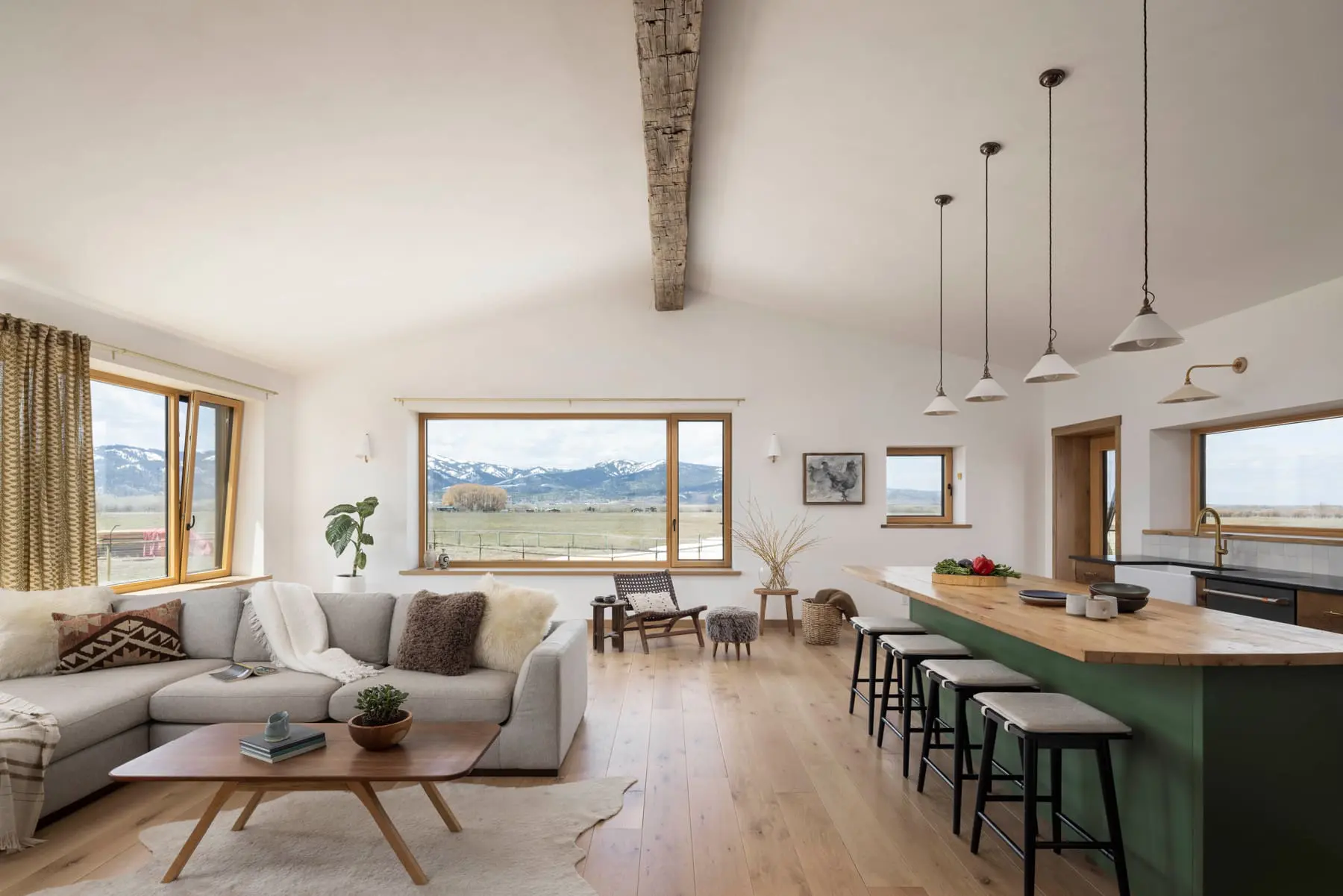
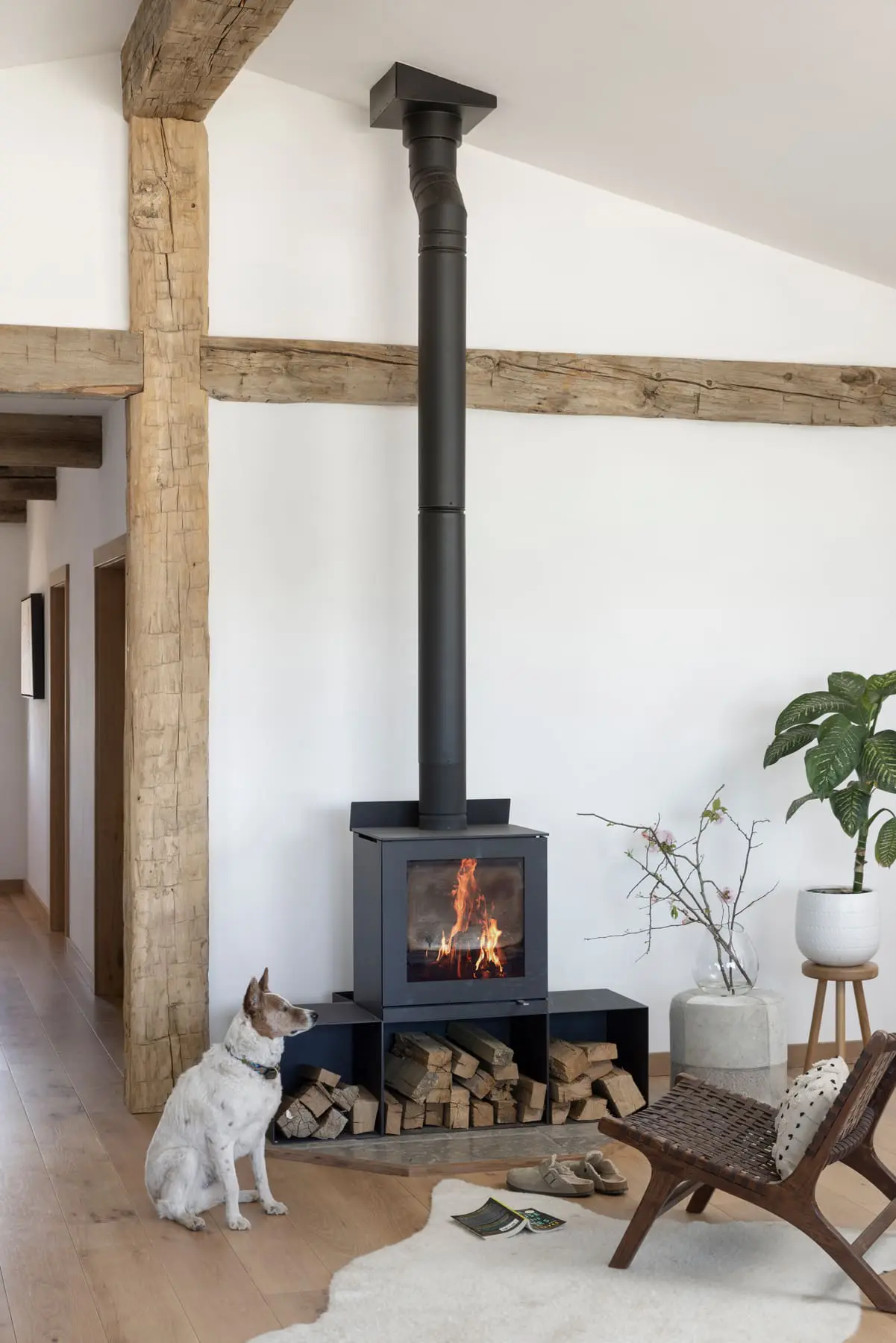
Broadly speaking, biophilic design includes the use of elements, such as daylight, views, plants, water, natural materials, and natural ventilation. It incorporates natural shapes and forms that echo living systems and relies on natural patterns and processes, such as variation in light and shadow, and textures that age and weather. Biophilic design captures daylight and views so occupants can feel both openness and safe enclosure, and it emphasizes relationships to local ecology, culture, materials, and history. Finally, biophilic design taps into our emotional and cognitive responses to place, to create spaces that feel engaging and meaningful, rather than merely functional.
“Biophilia is not a term we often hear from clients,” says Matt Thackery, a principal at Prospect Studio in Jackson. “But it’s definitely one I’m familiar with. We may not use the word, but biophilia is in everything we do.
“The big thing with biophilic design is making people aware of the sense of harmony in the spaces they occupy,” he continues, “Biophilia looks at things comprehensively. It includes unity, community, and sustainability. We can design all sorts of whizbang gadgets, but if we’re not adopting that lifestyle, it’s really not biophilia.
“We’re all [in the Tetons] to commune with nature,” Thackery says. “That’s why we came to this area. We want to be connected to the natural world. Biophilic design brings us back to the idea that there is a lot of unity and harmony in the world, and we should embrace that and include it in the things we build.”
Adam Riley, owner of Cloud 9 Building in Victor, says he sold his timberframe business a couple of years ago because he wanted to build structures he was proud of, rather than giant clubhouses on golf courses. He now builds two homes a year, and his passion is working with local materials that can be sculpted in beautiful ways.
“People have been using natural materials to build homes for thousands of years,” Riley says. “Today’s building codes are very new in terms of experience with the built environment. Even plywood has only been around since WWII, so it’s just 80 years old. I try to keep that in mind when I’m talking to building inspectors who think what I’m doing with straw bale structures is some hippy-dippy new idea.

“Part of what I love about building with straw and clay is the quality of space it creates,” he explains. “My home is really quiet. I don’t hear anything unless the windows are open. I love the rounded corners of straw bale walls. People have a strong affinity to natural materials. That’s what makes a biophilic home feel different.”
Blair Costello, a principal at Vera Iconica Architecture in Jackson and its director of interiors and healthy living, says fundamentally her work is determined by her clients, who want beautiful homes that let them live their best lives.
“My job is to guide clients to create a timeless and lasting space,” Costello says. “But I believe everyone should be doing [biophilic design]. It’s a huge piece of the larger puzzle of longevity of a home and wellness.”
For Costello, that means using as many natural materials as possible. Her firm now offers guidance on everything from paint color to interior furnishings.
“We added furnishings to our work a couple of years ago,” she says, “after we realized just how toxic things like flame retardants are. Beds can be one of the most toxic things in a house. Here we were delivering a healthy home from an architectural point of view, and then you put all these poisonous things into it.
Costello says that the more synthesized the materials are, the better the experience of the space will be. “Nobody really understands this until they walk into a space and realize it really does feel different.”